|
In a squared set, the two dancers in each couple are each other's partner. But when the dancers are arranged in this square formation, each dancer also has somebody on the other side, "around the corner" of the square. This person is called his/her corner. Each boy's corner is the girl to his left. Each girl's corner is the boy to her right.
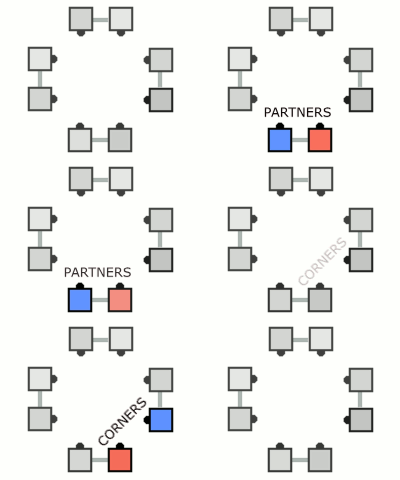
The term "partner" is also used in other formations where two dancers are standing side to side. In each pair, the dancers are considered each others partner, at that time, regardless of where they were when they squared up, and regardless of gender.
The term "corner" is also used in other formations to mean the adjacent person in the appropriate direction around the center of the set if everyone were facing in. In this sense, a boy's "corner" will be clockwise around the center of the set, and a girl's "corner" will be counter-clockwise around the center of the set.
Note that these other senses of partner and corner represent relationships that change as the dancers move around within a formation or from formation to formation. If it is necessary to distinguish between these temporary relationships and the relationships in the original squared set, the terms "Original Partner" and "Original Corner" may be used for the latter.